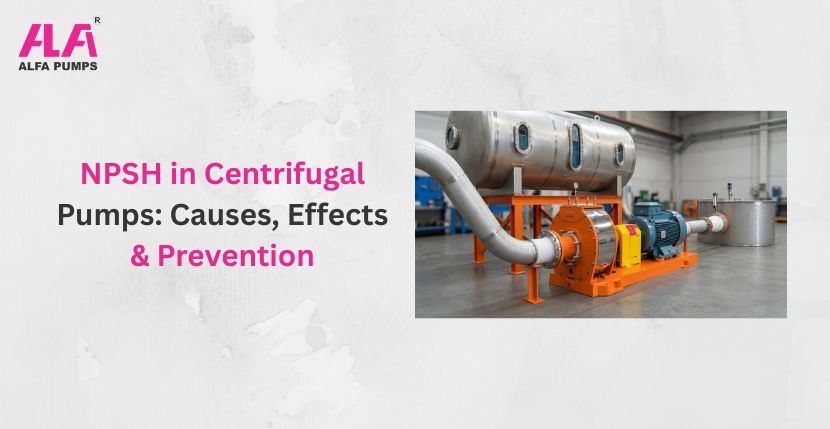
From water treatment plants to chemical processing units, pumps are the silent backbone of every industry. Yet, one small technical gap can lead to major breakdowns. That’s why you need to know why NPSH in centrifugal pumps is critical. Many plant operators ignore it until damage appears. The truth is simple, if suction conditions are wrong, efficiency drops instantly. Knowing the basics of net positive suction head in centrifugal pump systems helps prevent costly downtime. And this aspect ensures smoother operations across demanding environments.
What is Net Positive Suction Head (NPSH)?
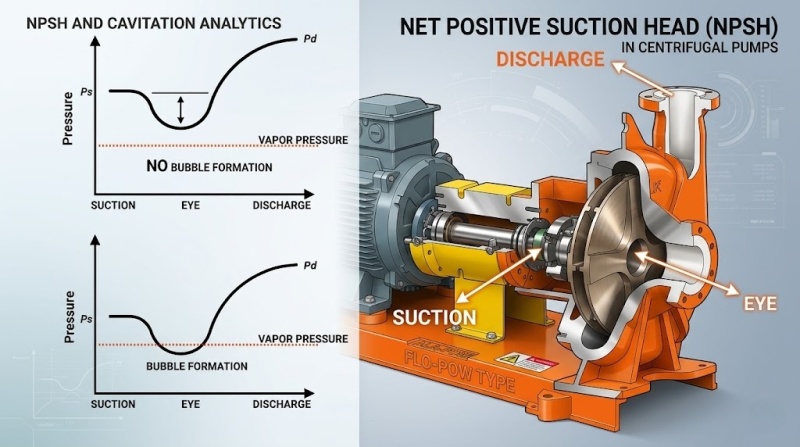
Net positive suction head in centrifugal pump refers to the pressure available at the pump suction compared to the liquid’s vapor pressure.
When pressure falls too low, the liquid starts forming vapor bubbles. These are not harmless because they collapse violently inside the pump. This is why having the know-how of NPSH in centrifugal pumps is a practical necessity. It ensures the liquid remains stable and avoids damage caused by pressure imbalances during pump operation.
Types of NPSH in Centrifugal Pumps: NPSH Available vs NPSH Required
In real-world applications, understanding NPSH available vs NPSH required is where most engineers make or break system performance. NPSH Available (NPSHa) is the actual pressure present at the suction side. It can be influenced by tank height, pipe losses and pump inlet pressure. NPSH Required (NPSHr), on the other hand, is defined by the pump manufacturer. This is the minimum pressure needed to avoid cavitation in pumps.
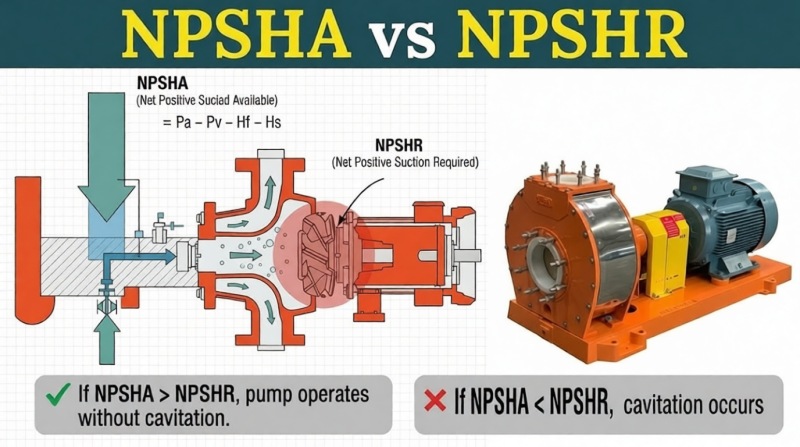
The gap between these two values is everything. If NPSH is higher, the pump runs smoothly. If not, trouble begins. This comparison helps operators make correct installation and design decisions. When analyzing NPSH in pumps, always ensure a safety margin exists.
Many Indian industrial failures occur because NPSH available vs NPSH required is ignored during setup. Even a small mismatch can result in vapor formation due to rising fluid vapor pressure in pumps, leading to long-term damage. This is why engineers must repeatedly evaluate before commissioning.
Recommended NPSH Safety Margin:
In practical industry use, only keeping NPSHa slightly higher than NPSHr is not enough. A proper safety margin must always be maintained.
- In water applications: keep at least 0.5 to 1 meter margin
- chemicals or volatile fluids: 1 to 3 meters margin
- For critical operations: even higher margin is recommended
This extra margin helps handle:
- Temperature changes
- Flow variations
- Measurement errors
Without safety margin, even a small change in operating condition can cause cavitation.
How to Calculate NPSH in Centrifugal Pumps:
NPSH of pump calculation is essential for engineers working in process industries. The basic NPSH formula considers atmospheric pressure, suction head, friction losses and vapor pressure of the liquid. In Indian conditions, temperature variations significantly impact fluid vapor pressure in pumps. Thus, an accurate calculation is extremely significant.
Basic NPSH Formula:
NPSHa = Atmospheric Pressure + Static Head – Vapor Pressure – Friction Losses
Simple Example:
If:
- Atmospheric pressure = 10 m
- Static head = 5 m
- Vapor pressure = 2 m
- Friction loss = 1 m
Then:
NPSHa = 10 + 5 – 2 – 1 = 12 m
When performing NPSH of pump calculation, always include pipe friction losses and elevation differences. This ensures realistic results. Many professionals dealing with NPSH in centrifugal pumps rely on simplified assumptions. Such things can cause pump failure. A correct calculation of NPSH in a pump helps maintain stable suction conditions and prevents operational risks in demanding applications.
Understanding NPSH Curve and Flow Relationship:
One important thing many engineers ignore is that NPSHr is not constant.
- NPSHr increases when flow rate increases
- Operating far from Best Efficiency Point (BEP) increases cavitation risk
- Oversized pumps can create suction problems
Always check pump performance curves before finalizing the system.
What Causes Low NPSH in Centrifugal Pumps?
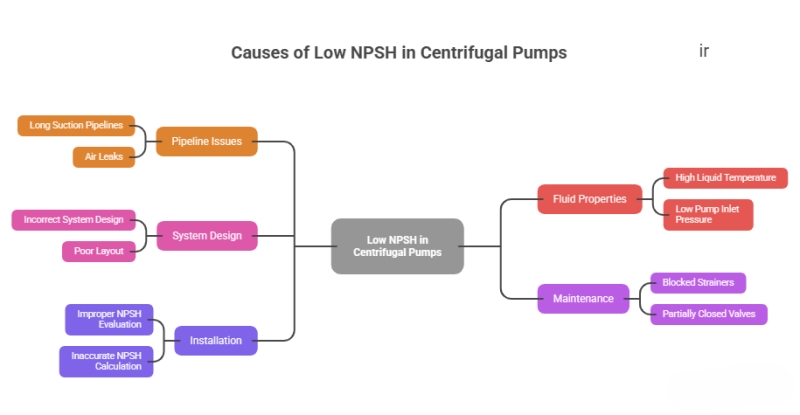
- Long suction pipelines increase friction losses, reducing NPSH in pumps efficiency
- High liquid temperature raises fluid vapor pressure in pumps, lowering available suction head
- Low pump inlet pressure due to poor tank elevation or suction lift issues
- Incorrect system design ignoring net positive suction head in centrifugal pump requirements
- Blocked strainers or partially closed valves restricting flow at suction
- Poor layout affecting hydraulic head in pumps, leading to pressure imbalance
- Air leaks in suction line reducing effective pressure
- Improper evaluation of NPSH available and NPSH required during installation
- Inaccurate NPSH of pump calculation causing mismatch in real operating conditions
Read Also: Dry Running in Pumps: Causes, Effects & Protection Tips
Effects of Insufficient NPSH in Centrifugal Pumps = Cavitation Problems
When net positive suction head in pump systems drop below required levels, cavitation begins. This leads to the formation of vapor bubbles in the pump impeller, which collapse with force and damage internal surfaces. Over time, this causes noise, vibration, reduced efficiency, and even pump corrosion due to continuous surface damage.
One of the biggest risks of poor suction conditions is damage to the pump impeller design, which directly impacts performance and efficiency.. This can destroy impellers and reduce equipment life drastically. Industries in India often face unexpected shutdowns due to this issue. Ignoring NPSH available and NPSH required directly leads to such failures. Cavitation is one of the most expensive operational problems.
How to Prevent NPSH Problems in Centrifugal Pumps:
- Always ensure that NPSH available and NPSH required has a sufficient safety margin. This is non-negotiable. Reducing suction pipe length and avoiding sharp bends helps maintain better pump inlet pressure.
- Temperature control is equally important. Rising heat increases fluid vapor pressure in pumps. Installing pumps closer to the liquid source improves suction conditions. Regular maintenance ensures no blockages that could reduce flow efficiency.
- Engineers must also focus on accurate NPSH of the pump during system design. Ignoring this step often leads to long-term failures. Another effective approach is monitoring hydraulic head in pumps, ensuring pressure stability at all times.
- Most importantly, you need to know the right balance of NPSH available vs NPSH required at every stage. From design to operation, this balance ensures reliability.
Importance of Proper Pump Selection in Chemical Applications:
In chemical industries across India, selecting the right pump is a must. Fluids often operate at high temperatures, increasing fluid vapor pressure in pumps. This directly affects suction conditions. Thus, NPSH in pumps is a key factor during selection.
Choosing a pump without evaluating net positive suction head in centrifugal pump requirements can lead to severe damage. Engineers must carefully analyze NPSH available vs NPSH required before finalizing equipment. Additionally, precise NPSH of pump ensures compatibility with system conditions.
Why Indian Industries Are Switching to Alfa Pumps
At Alfa Pumps, we solve real industrial problems. Our systems are engineered with precise NPSH of pump and designed to handle challenging Indian conditions. We assure:
- Accurate NPSH of pump calculation for Indian conditions
- Strong expertise in NPSH in centrifugal pumps
- Clear analysis of NPSH available & NPSH required
- Reliable designs for net positive suction head in centrifugal pump stability
- Reduced cavitation, longer pump life, lower downtime costs
Switch to Alfa Pumps…TODAY!
With deep expertise in NPSH in centrifugal pumps, we ensure zero compromise on performance. If you want reliability, efficiency and long-term savings, buy Alfa Pumps. Connect with us today, because here engineering meets trust and your operations run without unexpected failures.
FAQs:
NPSH in centrifugal pumps is the pressure available at the suction side above the liquid’s vapor pressure. It helps prevent cavitation and ensures smooth operation.
Proper NPSH ensures there is enough suction pressure so vapor bubbles do not form. Low NPSH can damage the pump and reduce efficiency.
NPSH of pump calculation includes atmospheric pressure, suction head, losses and vapor pressure. Proper calculation avoids suction-related problems.
NPSH is suction pressure, NPSHa is the actual pressure available, and NPSHr is the minimum pressure required. This comparison helps ensure safe pump operation.
NPSH 3% means the pressure where pump head drops by 3% due to cavitation. It is used to define NPSH required by pump manufacturers.
To increase NPSH, reduce suction pipe length, avoid bends and keep pump close to the liquid source. This improves suction pressure.
NPSH is measured in meters or feet of liquid column at pump suction. It shows how much pressure is available above vapor pressure.

Mr. Sanket Patel is a visionary industrial leader and managing director of Alfa Pumps. He leads the company’s innovation in fluid handling solutions, focusing on chemical process pumps designed for corrosive fluids.