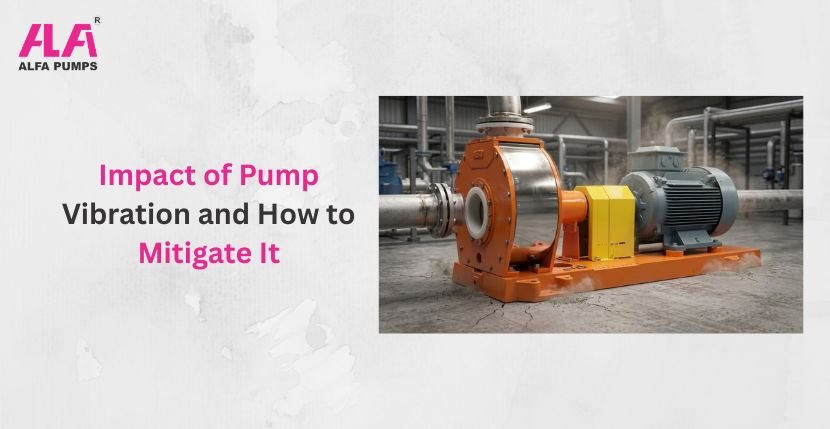
If you work in a plant with pumps, you already know this sound. A small buzz that slowly turns into a rattle. Engineers call that rattling sound centrifugal pump vibration. If your pump is making this noise, please don’t ignore it. There is some problem inside, maybe with the bearing, alignment, or impeller. If you delay checking it, the pump can get badly damaged, raising repair costs a lot.
The Costly Consequences of Unmitigated Pump Vibration:
If left unattended, vibration does not keep the damage small. It spreads. Pumps don’t fail overnight. It usually starts small — a seal leaks, bearings wear out faster than usual, or someone scratches the shaft and nobody checks it. But leave it unattended, and this small issue turns into a full breakdown.
In Indian process plants, this kind of unplanned downtime is not cheap. Depending on the industry and plant size, companies can lose anywhere from ₹50,000 to even ₹5 lakh in a day. And that’s just the production loss.
Then there’s the emergency repair cost, workers pulled off their regular job to fix it. A safety risk too, since workers standing near a failing pump are never really safe.
What starts as a minor shake can end up as a major shutdown. Shutdowns are always more expensive than prevention.
Primary Causes of Centrifugal Pump Vibration:
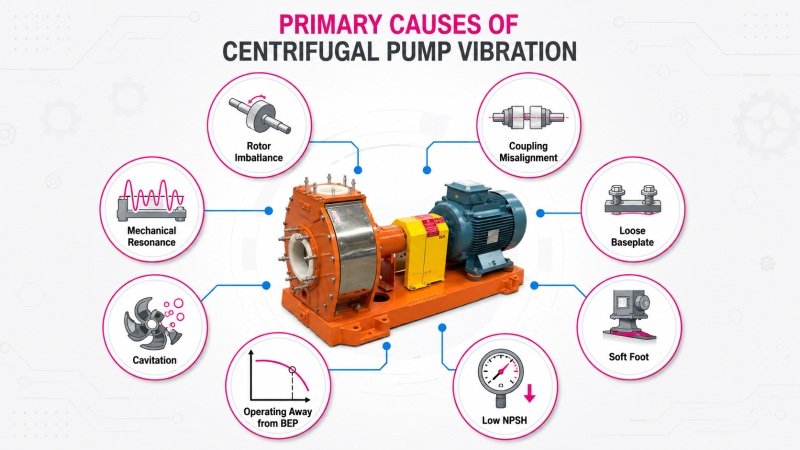
There is rarely just one reason behind pump vibration causes. Usually, it is a mix of mechanical and hydraulic issues working together. On the mechanical side, common culprits are rotor imbalance, coupling misalignment, a loose baseplate, or a soft foot condition (where one leg of the pump isn’t sitting flat). On the hydraulic side too, many problems come up. Cavitation is one common issue. Low NPSH is another — it often causes the pump to run rough.
Sometimes the pump is simply not working at its best efficiency point (BEP), and this alone can create flow instability. Improper impeller balancing or mechanical resonance can slowly build vibration over several weeks. Most of the time, nobody notices it until it becomes a bigger problem.
This is especially common in plants running abrasive slurry handling pumps, where suspended solids accelerate impeller wear.
Shaft Misalignment: Detection Methods and Correction Strategies
Shaft misalignment is one of the trickiest problems to catch, simply because you cannot see it with your eye. It happens when the pump shaft and motor shaft are not perfectly in line — either at an angle or side by side. Left as it is, this puts extra load on bearings and coupling assemblies, which wears them out much faster than normal.
To detect it, most Indian plants now rely on laser alignment tools instead of the old dial indicator method, since lasers give a far more accurate reading in less time. Once misalignment is confirmed, the fix usually involves adjusting shims under the motor base and re-checking alignment in both horizontal and vertical planes. Doing this correctly during pump commissioning itself can save a lot of trouble down the line.
This risk is higher in high-temperature ATEX zones, where PFA and PVDF lined pumps are often used. Thermal expansion in these environments can quietly shift alignment if it isn’t rechecked regularly.
How to Diagnose Vibration Problems Before They Escalate
Vibration problems don’t fix themselves, and by the time a pump starts making noise, you’ve usually already lost money. That’s why most plants today rely on condition monitoring — catching the issue while it’s still small.

Here’s how it usually works on the ground:
- Technicians carry vibration analysers during rounds. These handheld devices measure vibration in mm/s, and anything crossing 4.5 mm/s RMS (as per ISO 10816) is usually a red flag for industrial pumps.
- Thermal cameras are another favorite. Point one at a bearing or motor winding, and you can spot heat building up long before anything actually fails.
- Then there’s ultrasonic testing, which is honestly underrated. It picks up early lubrication issues in bearings well before you’d ever hear a sound.
- Oil analysis is the old-school method, but it still works. Metal particles showing up in the lubricant sample are usually the first real sign that something’s wearing out internally.
And lately, more plants across India are moving to online sensors that monitor conditions round the clock and send alerts straight to the control room — no more waiting for the weekly manual check. This shift, though it needs some upfront investment, pays off by catching problems days or even weeks before a shutdown becomes necessary.
Proven Mitigation Strategies for Industrial Pump Vibration
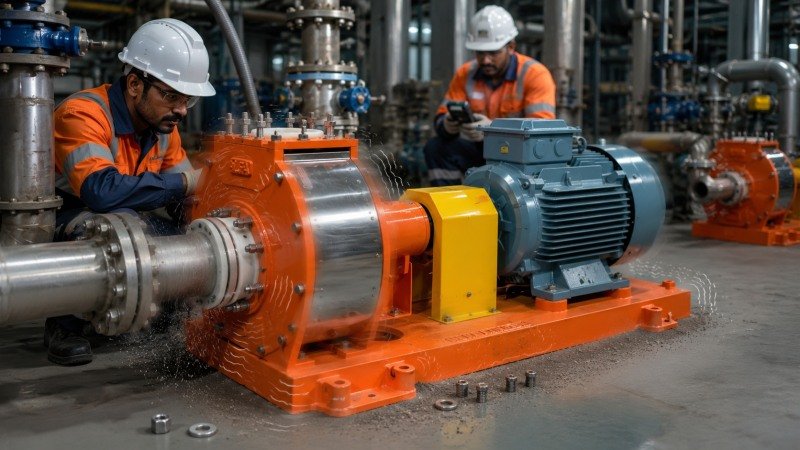
Once the cause is known, pump vibration mitigation becomes a fairly straightforward job. For rotor imbalance, dynamic balancing of the impeller usually solves the issue. For misalignment, laser alignment and proper shimming work well. Loose baseplates need re-grouting or re-tightening of anchor bolts, and a soft foot condition can be corrected by adding shims at the specific leg that is not sitting flush. On the hydraulic side, adjusting the operating point closer to BEP, and checking suction piping for air pockets, goes a long way in cutting down flow-related vibration.
Operational and Design Choices That Reduce Vibration
Sometimes the fix is not in the pump itself but in how it is being run. Operating a pump far away from its best efficiency point, for long hours, is one of the biggest reasons for premature vibration issues in Indian plants — especially where load demand keeps changing throughout the day. Choosing the right pump size for the actual duty point (not an oversized one “just to be safe”) avoids running the pump inefficiently. Piping design also matters — long, unsupported pipe runs near the pump can transmit vibration back into the system. Adding proper pipe supports and flexible couplings where needed reduces this transfer significantly.
This becomes even more critical with high-capacity chemical transfer pumps, where running far from the design flow rate under heavy load can amplify vibration and hydraulic instability significantly.
Why Non-Metallic Materials Help Reduce Pump Vibration
Non-metallic pumps, made from materials like polypropylene or PVDF, are increasingly being used in chemical and water treatment plants across India. These materials naturally absorb vibration better than metal casings, since they are less rigid and dampen minor resonance on their own. This means lower stress on bearings and mechanical seals over time, along with better resistance to corrosion — a double benefit for plants handling aggressive chemicals.
Read Also: PP Pump vs. PVDF Pump: Simple Comparison for Buyers
Maintenance Best Practices to Sustain Low Vibration Long-Term
Consistency is what keeps vibration low over the long run. A simple monthly checklist works wonders:
- Check bearing lubrication levels and top up or replace as per schedule.
- Inspect coupling assemblies for wear every quarter.
- Re-verify shaft alignment after any major maintenance work.
- Keep a logbook of vibration readings to spot slow, gradual trends.
Plants that do regular maintenance break down much less. Compare this to plants that only fix things after they stop working — those units face more problems and more downtime.
Conclusion: Vibration Management as a Strategic Operational Advantage
Pump vibration is not just a maintenance headache — it is a signal that, if read correctly, can save real money and downtime. Plants that treat vibration monitoring as a routine part of operations, rather than an afterthought, end up with pumps that run longer, safer, and more efficiently. In the end, good vibration management is not an added cost — it is a smart investment in reliability.
FAQs:
A centrifugal pump can vibrate due to many reasons — rotor imbalance, shaft misalignment, loose baseplate, or soft foot condition. On the hydraulic side, cavitation, low NPSH, and operating away from the best efficiency point (BEP) are also very common causes.
Yes, absolutely. Excess pump vibration is not just a mechanical problem — it is a safety risk too. Workers standing near a failing pump can get hurt, and uncontrolled vibration can lead to sudden breakdowns, causing unplanned plant shutdowns and heavy production losses.
The first sign is usually a buzzing or rattling sound coming from the pump unit. You can confirm it using a vibration analyser — if readings cross 4.5 mm/s RMS as per ISO 10816, your pump needs immediate attention before damage spreads further.
Shaft misalignment happens when the pump shaft and motor shaft are not perfectly in line — either angularly or laterally. This puts extra load on bearings and coupling assemblies, wearing them out faster and creating continuous vibration that worsens over time if not corrected.
Ideally, vibration readings should be taken during every maintenance round — at minimum, monthly. Bearing lubrication should be checked monthly, coupling assemblies inspected quarterly, and shaft alignment re-verified after any major maintenance work to maintain consistently low vibration levels.

Mr. Sanket Patel is a visionary industrial leader and managing director of Alfa Pumps. He leads the company’s innovation in fluid handling solutions, focusing on chemical process pumps designed for corrosive fluids.