Ask any process engineer working with corrosive or aggressive chemicals. They’ll tell you that pump head is one of those terms that sounds technical but is actually quite simple.
So, what is a pump head? It is simply the height to which a pump can push fluid. Pump head is expressed in meters, not liters per minute or bar. It tells you how much “lift” a pump has, both pulling fluid in and pushing it out.
Whether you’re sizing a PVDF-lined pump for a bromine transfer line or a PP centrifugal pump for an acid dosing skid, understanding head is where the real decision-making begins.
Why Pump Head is Measured in Height, Not Pressure?
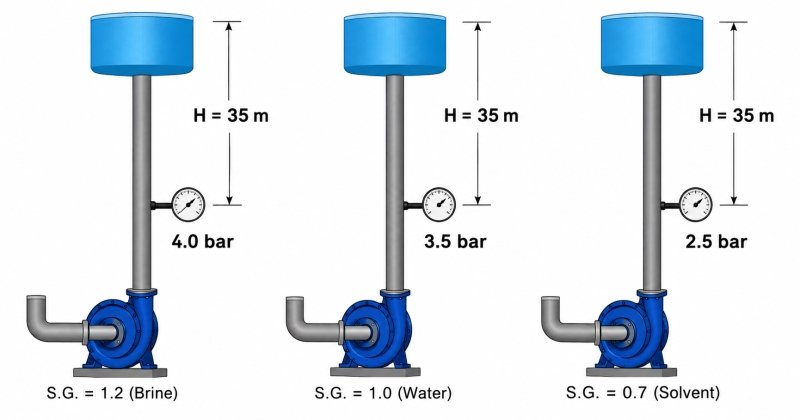
Pressure changes based on the fluid, but pump head remains the same even when the fluid’s specific gravity changes. That’s why engineers prefer head over pressure when talking about centrifugal pump head, especially in chemical processing where different fluids can have very different specific gravities.
A pump doesn’t really “know” pressure; it converts mechanical energy from the impeller into velocity and elevation, which is far easier to express as height. For context, 1 bar of pressure works out to roughly 10.2 meters of head for plain water.
That figure changes whenever the specific gravity changes, and in chemical processing, this can happen often. A strong acid or a heavier process fluid can have a specific gravity much higher than 1.0. This means the same pressure reading will give a different head value compared with water. That is why pump engineers use head instead of pressure when selecting pumps for corrosive or heavier fluids. Think of it like measuring your fitness by how many stairs you can climb. The stairs are the same, but how tired you feel may change each time.
What is Suction Pump Head?
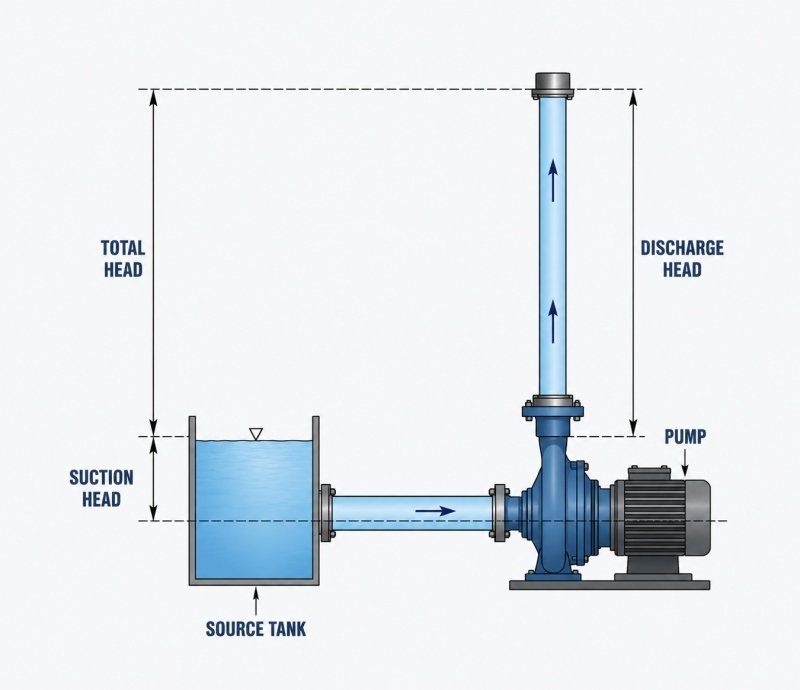
Suction head in a pump refers to the height and pressure conditions on the inlet side. In simple terms, it describes how the pump receives liquid before sending it forward.
When the source tank is above the pump, it creates a positive suction head. This is common with gravity-fed acid or alkali storage tanks. When the source tank is below the pump, the pump needs to lift the liquid upward. This is common with sump pits that collect wastewater or underground chemical storage tanks. This is called suction lift and can be more difficult to manage. The height of the liquid, pressure, and resistance from the suction pipe all affect pump performance.
Suction Lift Limits and Cavitation Risk:
There is also a limit to how high a pump can lift liquid using atmospheric pressure. At sea level, atmospheric pressure can theoretically support a water column of about 10.3 meters. In real-world conditions, most centrifugal pumps start struggling once suction lift crosses roughly 7–8 meters — and with corrosive or high-vapor-pressure chemicals, that practical limit can be even lower, since these fluids are more prone to flashing under reduced pressure at the pump inlet.
When the source tank sits above the pump, you usually have a good amount of suction pressure. But if that safety margin becomes too small, pipe friction, high fluid temperature, and vapor pressure can quickly reduce it. Low suction pressure can cause cavitation in the pump. You may hear a rattling or crackling sound when there is not enough liquid reaching the pump.
In chemical applications, cavitation is more than just a noise issue. It can cause faster wear of pump parts that come into contact with the liquid. It may also damage the seals, especially when handling harsh chemicals. You can prevent this problem by calculating the suction head correctly. Always consider it when selecting and sizing the pump instead of relying on an estimate.
What is Discharge Head?
Discharge head is the other side of the equation. It refers to the total height and resistance the pump has to overcome on the outlet side to deliver the fluid where it is needed.
This includes the static discharge head, which is the vertical distance to the discharge elevation. It also includes friction losses in the delivery pipe and velocity head. Finally, you need to account for any pressure required at the endpoint, such as a dosing nozzle, reaction vessel, or scrubber system.
Longer pipe runs, more bends, and smaller pipe diameters all add to the discharge head. The vertical distance may stay the same, but these factors increase the overall resistance in the system. This matters even more in chemical transfer lines. Pipework is often made from PP, PVDF, or lined steel instead of standard PVC. There are also usually more fittings because of isolation valves, sampling points, and containment loops. As a simple guide, friction losses of 2–5 meters per 100 meters of pipe length are common even in well-sized process lines carrying fluids at typical flow rates — and this loss increases with thicker or heavier chemical fluids.
That’s before you’ve even counted the elbows, valves, and fittings along the way. Honestly, this is where a lot of pump selection goes wrong in practice: people account for elevation but forget friction losses altogether, and then wonder why flow rate drops mid-system — a problem that shows up fast when you’re metering a dosing line to a tight tolerance.
What is Total Dynamic Head (TDH)?
Now we get to the big one. Total dynamic head, or TDH, is essentially suction head and discharge head combined, plus all the friction and velocity losses along the way.
Think of it as the complete resistance journey your pump has to fight through — from the source tank, right up to the final delivery point, whether that’s a reactor, a scrubber, or a downstream process unit. TDH isn’t just a number engineers throw around to sound impressive; it’s the single most important figure when picking the right pump for a job.
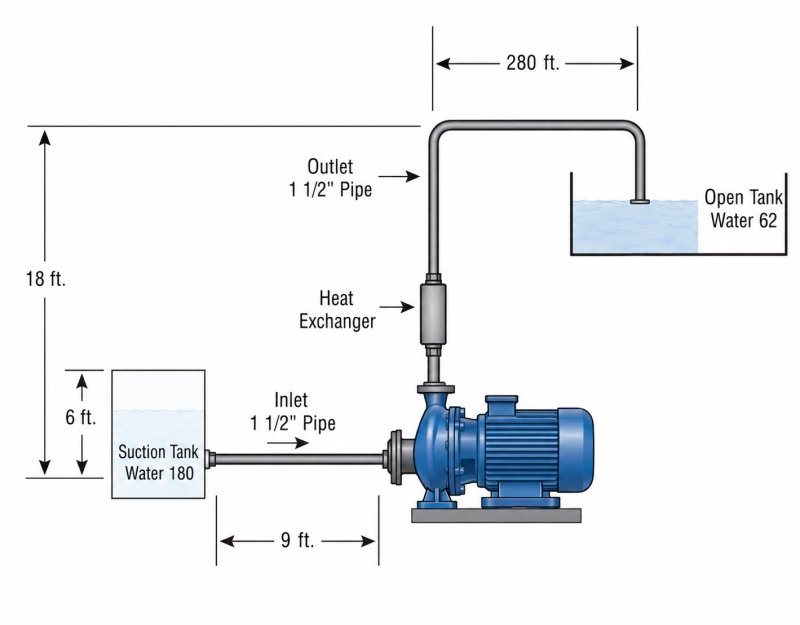
Undersize it, and your pump will struggle, overheat, or simply fail to deliver adequate flow — a real problem when you’re dosing a chemical reaction that depends on consistent flow rates. Oversize it, and you’re wasting energy and money on a pump doing more work than necessary, while also increasing wear on seals and wetted parts that are already working against a corrosive fluid.
At Alfa Pumps, this is often the very first calculation our team walks customers through — because everything else, from impeller diameter to motor rating to material selection (PP, PVDF, PFA, or UHMW-PE), depends on getting TDH right.
How to Calculate Total Dynamic Head (Step-by-Step)?
Calculating TDH isn’t rocket science, but it does need a methodical approach. Here’s a simple breakdown:
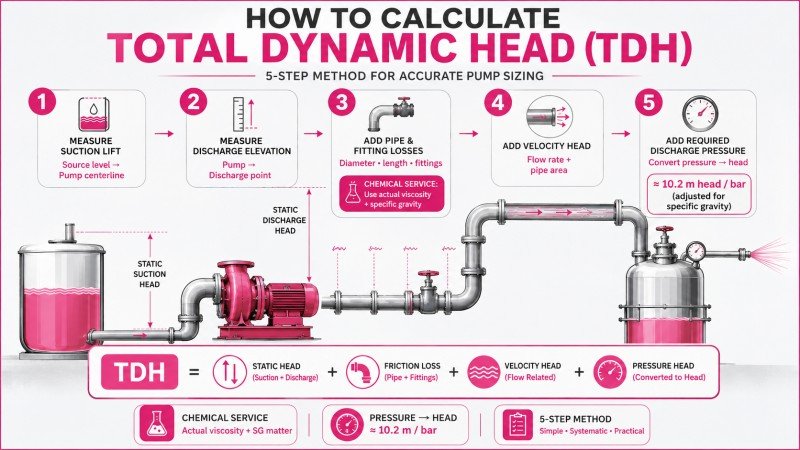
Step 1: Measure static suction head (or lift) — the vertical distance from the source tank or sump to the pump centerline.
Step 2: Measure static discharge head — the vertical distance from the pump to the discharge elevation.
Step 3: Add friction losses in both suction and discharge piping, based on pipe diameter, material, length, and number of fittings. In chemical service, factor in the fluid’s actual viscosity and specific gravity rather than defaulting to water-based assumptions — a viscous or dense process fluid will rack up more friction loss over the same run than water would.
Step 4: Add velocity head, calculated from flow rate and pipe cross-section.
Step 5: Add any residual pressure required at the discharge point — for instance, injection pressure into a reactor or pressure needed to atomize at a dosing nozzle — converted into head using that 10.2-meters-per-bar benchmark we talked about earlier, adjusted for the fluid’s specific gravity.
Add all of these together, and voilà — that’s your TDH. Most manufacturers, including Alfa Pumps, provide a pump performance curve so you can cross-check your calculated TDH against expected flow rate before finalising a model.
Why Total Dynamic Head Matters for Pump Selection?
You wouldn’t buy safety gear without knowing what chemical you’re handling, right? Same logic applies here. TDH directly determines which pump model, impeller diameter, motor horsepower, and — critically, in chemical service — wetted material will actually work for your application.
Choose a pump below the best efficiency point (BEP) for your TDH, and you risk pump deadhead conditions, excess vibration, and premature wear on seals that are already under chemical attack. Here’s a number worth remembering: operating just 20% away from BEP can drop pump efficiency by 10–15%, based on typical pump performance curve data.
That gap shows up directly on the electricity bill over months of continuous use — and in corrosive-fluid applications, inefficient operation often shows up even faster as accelerated seal or component wear. Correct TDH calculation protects your equipment, your uptime, and your process consistency.
Read Also: Ways to Cut Pump Operational Costs & Improve Performance
Suction Head vs Discharge Head vs Total Dynamic Head: Quick Comparison
| Parameter | What It Measures | Key Factors |
| Suction Head | Inlet side lift/pressure | Static suction head, pipe friction, elevation, vapor pressure of the fluid, 7–8 m practical lift limit (often lower for volatile chemicals) |
| Discharge Head | Outlet side resistance | Static discharge head, friction loss (2–5 m per 100 m pipe, higher for viscous/dense fluids), velocity head |
| Total Dynamic Head | Complete system resistance | Suction head + discharge head + all losses |
Simply put, suction and discharge head are pieces of the puzzle; TDH is the full picture.
Read Also: NPSH in Centrifugal Pumps: Simple Fixes for Better Pump Life
Conclusion:
Understanding pump head becomes much simpler when you look at it as the total resistance a fluid must overcome in your system. Suction head, discharge head, and total dynamic head all play a role in determining whether a pump will deliver the required flow efficiently.
In chemical and process environments, getting this right matters even more than in general water service, because you’re not just losing flow rate — you’re risking seal integrity, wetted-part life, and process consistency when handling corrosive or aggressive fluids. Get your calculations right, respect the physical limits on suction lift, and account for every meter of friction loss, and you’ll save on energy, reduce wear, and pick a pump that actually performs in demanding chemical duty.
Not sure where to start? Alfa Pumps’ team can help you work through the numbers and match you with a corrosion-resistant pump Suited to your specific process requirements.
FAQs About Centrifugal Pump Head:
The centrifugal pump head calculation includes static lift, suction losses, discharge losses, velocity head, and required pressure at the delivery point. Add these values to determine TDH.
Total head of a centrifugal pump is the complete resistance the pump must overcome, including elevation difference, pipe friction, velocity losses, and pressure required at the discharge point.
Suction head relates to conditions on the pump inlet side, while discharge head covers outlet elevation and resistance. Both contribute to the pump’s required total dynamic head.
Suction lift is the vertical distance between the liquid level in the source tank and the pump centreline when the liquid level is below the pump.
Discharge head is the vertical elevation and system resistance the pump must overcome to deliver fluid. It includes pipe friction, fittings, valves, velocity losses, and endpoint pressure.
Total Dynamic Head (TDH) represents the complete pumping requirement, combining static elevation, suction and discharge losses, pipe friction, velocity head, and required discharge pressure.
Yes. Pipe diameter and pump head loss are closely connected. Smaller pipes generally create higher friction losses, increasing the total head required from the centrifugal pump.

Mr. Sanket Patel is a visionary industrial leader and managing director of Alfa Pumps. He leads the company’s innovation in fluid handling solutions, focusing on chemical process pumps designed for corrosive fluids.