The Indian pump industry is growing fast — water infrastructure, agriculture, construction, and process industries all depend on reliable pumping equipment, and this is driving demand. But growth brings pressure: manufacturers face tighter delivery deadlines, raw-material costs keep rising, and customers expect consistent quality on every single unit. Pump manufacturing today demands more than good engineering — it also requires manufacturers to manage the entire production process well behind the scenes.
At Alfa Pumps Pvt. Ltd., we’ve seen first-hand that building a great pump is only half the battle. The other half is running the business behind the pump — production planning, inventory, costing, and dispatch — with the same precision we put into our engineering. This article shares how digital transformation is changing the way pumps are designed, manufactured, and delivered.
The Hidden Complexity Behind Every Pump:
A single centrifugal or industrial pump can involve dozens of components — impellers, casings, shafts, seals, bearings, motors, and fasteners. Many are cast or machined in-house; others are bought out. Coordinating all of this manually leads to familiar problems:
- Material shortages discovered only when production has already started
- Stock pile-ups of slow-moving components that tie up working capital
- Costing guesswork, where the true cost of a finished pump isn’t known until much later
- Delivery slippage, because nobody has a single, live view of what’s on the shop floor
These aren’t engineering problems. They’re information problems — and that’s exactly where digital systems help.
Where Digitisation Makes the Biggest Difference:
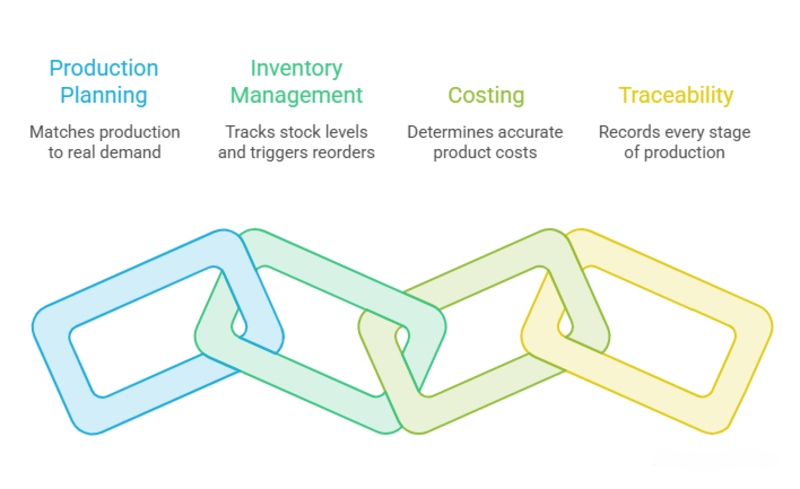
1. Production planning that matches real demand – Instead of building to gut feeling, modern manufacturers plan production against actual orders and forecasts. A bill of materials (BOM) for each pump model automatically tells you what to make, what to buy, and when.
2. Real-time inventory and procurement – When production consumes raw material against an order, the system updates stock instantly. Reorder levels automatically trigger purchase indents — so you never stop a production run because a ₹50 seal wasn’t on the shelf.
3. Accurate product costing – Knowing the true landed cost of every pump — material + labor + overhead — makes the difference between healthy margins and silent losses. Digital costing makes every quotation defensible.
4. End-to-end traceability – The system records every stage, from raw casting to dispatched unit. For quality-critical industries, buyers increasingly require this traceability, not just expect it as a nice-to-have.
The Role of a Pump Manufacturing ERP:
The system that ties all of this together is a manufacturing ERP. A good ERP connects sales orders, BOMs, production, inventory, purchase, and accounting into one live picture of the business. Cloud-based platforms have created a turning point here. Tools like manufacturing ERP software now bring production planning, inventory control, and GST-ready accounting within reach of factories that could never justify a heavyweight legacy system.
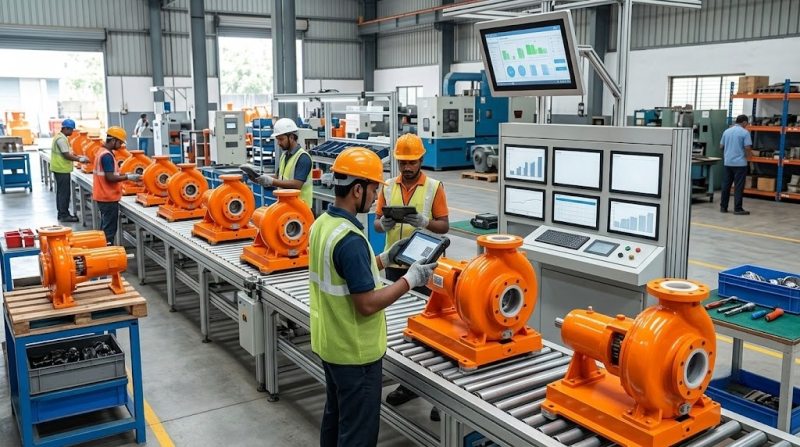
At Alfa Pumps, we run our own operations on OEMup, a cloud manufacturing ERP built for Indian SMEs. For a pump maker specifically, that means model-wise multi-level BOMs across materials of construction, weight-based costing, job-work tracking with ITC-04, and GST e-invoicing — in one system instead of Tally plus a dozen spreadsheets.
Why Non-Metallic Pumps Need More Precise Manufacturing Than Regular Pumps:
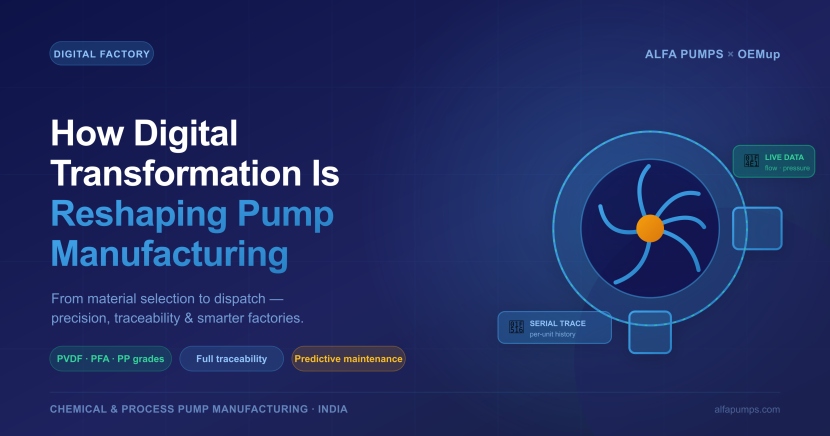
Not every pump is built from the same material — and in chemical service, the material is the product. PVDF, PFA, and PP are specialised engineering plastics used in chemical pumps because they resist aggressive media that would destroy metal. But these grades are expensive, and each comes in several variants with different chemical, thermal, and purity properties. Select the wrong grade and you don’t just scrap a part — you risk damaging the pump or contaminating the customer’s process.
The complexity multiplies because every pump model we build can call for a different material combination depending on exactly which chemical the customer is handling. Managing that by memory or spreadsheet is a real risk. A digital system lets us track precisely which material variant belongs to which customer order, so there is no confusion and no substitution error. When a pump is handling ultra-pure water, strong acids, or hazardous chemicals, there is zero room for error — and digital records make sure the right material goes into every single unit.
Traceability in Chemical Pump Manufacturing — From Raw Material to Dispatch
Buyers in pharmaceuticals, semiconductor fabrication, and chlor-alkali plants don’t just buy a pump — they buy the documentation that proves how it was made. For these industries, traceability is part of the deliverable.
Every pump we build carries its own unique serial number, and the digital system records every step of that unit’s history against it: which raw material batch was used, when it was machined, when it was assembled, when it was tested, and when it was dispatched. If a customer ever raises a quality concern, we can trace that specific pump back through every detail — its serial number, the material batch it came from, and the test results — instead of guessing.
We also keep separate quality records for each customer digitally, so a repeat order can be matched exactly to what was shipped before. Consistent documentation, unit after unit, is what turns a supplier into a long-term partner.
What Today’s Chemical Industry Buyers Expect From Their Pump Supplier:
Buyers in industries like chlor-alkali have become far more demanding. Before placing an order, they now ask pointed questions: Can you show us your quality records? What is your committed delivery time? Will the next order be exactly like the last one?
These buyers run continuous processes, where a single pump delay can halt an entire production line. So they favour suppliers who can commit to delivery dates with genuine confidence — not hope. Repeat-order consistency matters just as much: if the first pump performed perfectly, the second must be identical, and only a digital system can guarantee that repeatability.
A digitally organised supplier gives these buyers exactly what they want — fewer surprises, less back-and-forth, and the confidence that every unit will match the specification and the schedule they were promised.
The Future of Pump Manufacturing — Smarter Factories, Connected Pumps
In the years ahead, pumps won’t just move fluids — they’ll report on themselves. A connected pump can send real-time performance data back to the manufacturer, so if its flow rate drops, the system raises an alert automatically. That means a customer running a chemical plant gets a warning before a pump fails, instead of discovering it after production has already stopped. This is predictive maintenance in practice.
Manufacturers will also build a “digital twin” — a digital copy of each pump model that engineers can use to diagnose issues remotely, without visiting the customer site. Indian pump manufacturers, especially SMEs, are only beginning this journey. The companies that invest in digital systems today will be the ones leading the industry five years from now.
What This Means for Our Customers:
For us at Alfa Pumps, digital transformation isn’t a buzzword — it’s how we keep promises. Better planning means shorter lead times. Tighter inventory means competitive pricing. Full traceability means consistent quality on every unit we ship.
If you’re a pump buyer, that’s the quiet advantage you get when your supplier runs a connected, modern operation. And if you’re a fellow manufacturer, the message is simple: the engineering gets you in the game, but the systems behind it decide whether you scale.
FAQs About Digital Transformation Is Reshaping Pump Manufacturing:
Pump manufacturers need an ERP that handles model-and-material BOM variants, weight-based costing, foundry/machining job-work with ITC-04, and GST e-invoicing. Alfa Pumps uses OEMup, a cloud manufacturing ERP built for Indian SME manufacturers. Heavier options like SAP suit large enterprises but are usually overkill for SME pump makers.
Digital transformation helps pump manufacturers fix information problems like material shortages, stock pile-ups, and delivery delays. It connects production planning, inventory, and dispatch into one system for better control.
A single pump has dozens of components like impellers, casings, shafts, seals, bearings, and motors. Coordinating in-house and bought-out parts manually often leads to material shortages and costly delays.
A BOM for each pump model automatically tells the factory what to make, what to buy, and when. This allows production planning based on real orders, not guesswork.
When raw material is consumed against a production order, stock updates instantly. Reorder levels trigger purchase indents automatically, so production never stops due to missing parts.
Industries like pharma, semiconductor, and chlor-alkali demand complete audit trails. Digital systems record every production stage, from raw material to dispatch, ensuring full accountability.

Mr. Sanket Patel is a visionary industrial leader and managing director of Alfa Pumps. He leads the company’s innovation in fluid handling solutions, focusing on chemical process pumps designed for corrosive fluids.